
10 Best eCommerce/Shopify CRO Agencies in 2026: Results & Expertise
 Reading time: 17 min
Choosing the best eCommerce CRO agency requires more than comparing client logos or headline conversion uplifts. The right partner should understand your eCommerce platform, have documented A/B testing results, and know how to improve business metrics such as conversion rate, revenue per visitor, and average order value.
We compared 10 leading eCommerce CRO agencies based on published case studies, experimentation methods, team capabilities, client feedback, and eCommerce specialization.
This guide helps you compare full-service CRO agencies, Shopify-focused specialists, and DTC growth marketing teams to find the right partner for your online store.
Best eCommerce CRO Agencies at a Glance
The agencies below differ in their platform expertise, experimentation capabilities, and business focus. Some specialize in Shopify and DTC brands, while others support complex, enterprise-level eCommerce experimentation programs.
| Agency | Best For | Relevant Platforms | Main CRO Focus |
|---|---|---|---|
| Conversion Rate Store | Full-service, research-driven CRO | Shopify, general eCommerce, marketplaces | Full-funnel CRO, PDP, cart, subscriptions, mobile UX |
| Conversion | Enterprise eCommerce experimentation | Advanced experimentation methodology | Platform-agnostic eCommerce |
| Craftberry | Outcome-focused Shopify CRO | Shopify, Shopify Plus | Shopify CRO, experimentation, revenue optimization |
| SplitBase | Established DTC brands | Shopify, DTC eCommerce | PDP, bundles, landing pages, revenue optimization |
| Speero | Experimentation maturity | Platform-agnostic eCommerce | Research, cart UX, testing strategy, analytics |
| Blend Commerce | Shopify CRO and development | Shopify, Shopify Plus | PDP, product discovery, cart, development |
| The Good | Research-led eCommerce optimization | General eCommerce | Customer research, mobile UX, full-funnel testing |
| GrowthHit | DTC growth and conversion optimization | Shopify, DTC eCommerce | PDP, landing pages, acquisition, retention |
| Convertibles | Shopify brands needing rapid testing | Shopify, Shopify Plus | PDP, cart, offers, experimentation |
| Conversion Fanatics | Structured A/B testing | General eCommerce | Product messaging, offers, UX testing |
How to use this comparison: Start with your conversion challenges and platform requirements. An agency with strong Shopify development capabilities may be ideal for one business, while an experimentation consultancy with enterprise analytics expertise may be more relevant for another.
How We Evaluated eCommerce CRO Agencies
We evaluated each agency across five weighted criteria, prioritizing documented eCommerce results, experimentation expertise, and relevant platform capabilities.
| Evaluation Criteria | Weight | What We Considered |
|---|---|---|
| CRO Case Studies (CS) | 25% | Published experiments, named clients, and measurable conversion or revenue results |
| Process Rigor (PR) | 25% | Research, analytics, hypotheses, A/B testing, and statistical validation |
| Team Coverage (TC) | 15% | CRO strategy, UX research, design, development, and QA |
| Social Proof (SP) | 20% | Independent reviews, client testimonials, and industry recognition |
| eCommerce Specialization (VS) | 15% | DTC experience, platform expertise, PDP, cart, checkout, and subscriptions |
Scoring Method
Each criterion is rated from 0 to 5. The weighted score is multiplied by 20 to calculate the final rating out of 100.
Total Score = 20 × (0.25 CS + 0.25 PR + 0.15 TC + 0.20 SP + 0.15 VS)
Case Studies measures the strength of published CRO evidence, while eCommerce Specialization assesses its relevance to online stores and purchasing journeys.
Scoring Transparency & Editorial Disclosure
Conversion Rate Store is included in this comparison and evaluated using the same five weighted criteria as other agencies. Final scores are calculated without manual adjustments, and agencies are ranked by their total scores. Tied agencies share the same rank.
Ratings are based on publicly documented capabilities, case studies, methodologies, and client evidence reviewed in October 2026. Agency-reported results are considered self-reported unless independently verified.
Top 10 eCommerce CRO Agencies: Ranking & Scores
| Agency | Total | Case Studies | Process Rigor | Team Coverage | Social Proof | eComm Specialization |
| Conversion Rate Store | 95 | 5 | 4 | 5 | 5 | 5 |
| Conversion | 92 | 5 | 5 | 5 | 3 | 5 |
| Craftberry | 91 | 4 | 5 | 5 | 4 | 5 |
| SplitBase | 88 | 5 | 4 | 4 | 4 | 5 |
| Speero | 88 | 4 | 5 | 5 | 4 | 5 |
| Blend Commerce | 88 | 5 | 4 | 4 | 4 | 5 |
| The Good | 86 | 5 | 4 | 3 | 5 | 4 |
| GrowthHit | 85 | 5 | 4 | 4 | 4 | 4 |
| Convertibles | 83 | 4 | 4 | 4 | 4 | 5 |
| Conversion Fanatics | 75 | 4 | 3 | 4 | 4 | 4 |
1. Conversion Rate Store
Best For: eCommerce brands seeking a fully outsourced CRO team to improve conversions and revenue through research-driven experimentation.
Relevant Platforms: Shopify, general eCommerce, and marketplaces.
Main CRO Focus: Full-funnel CRO, product pages, cart, subscriptions, mobile UX, and revenue optimization.
Overview
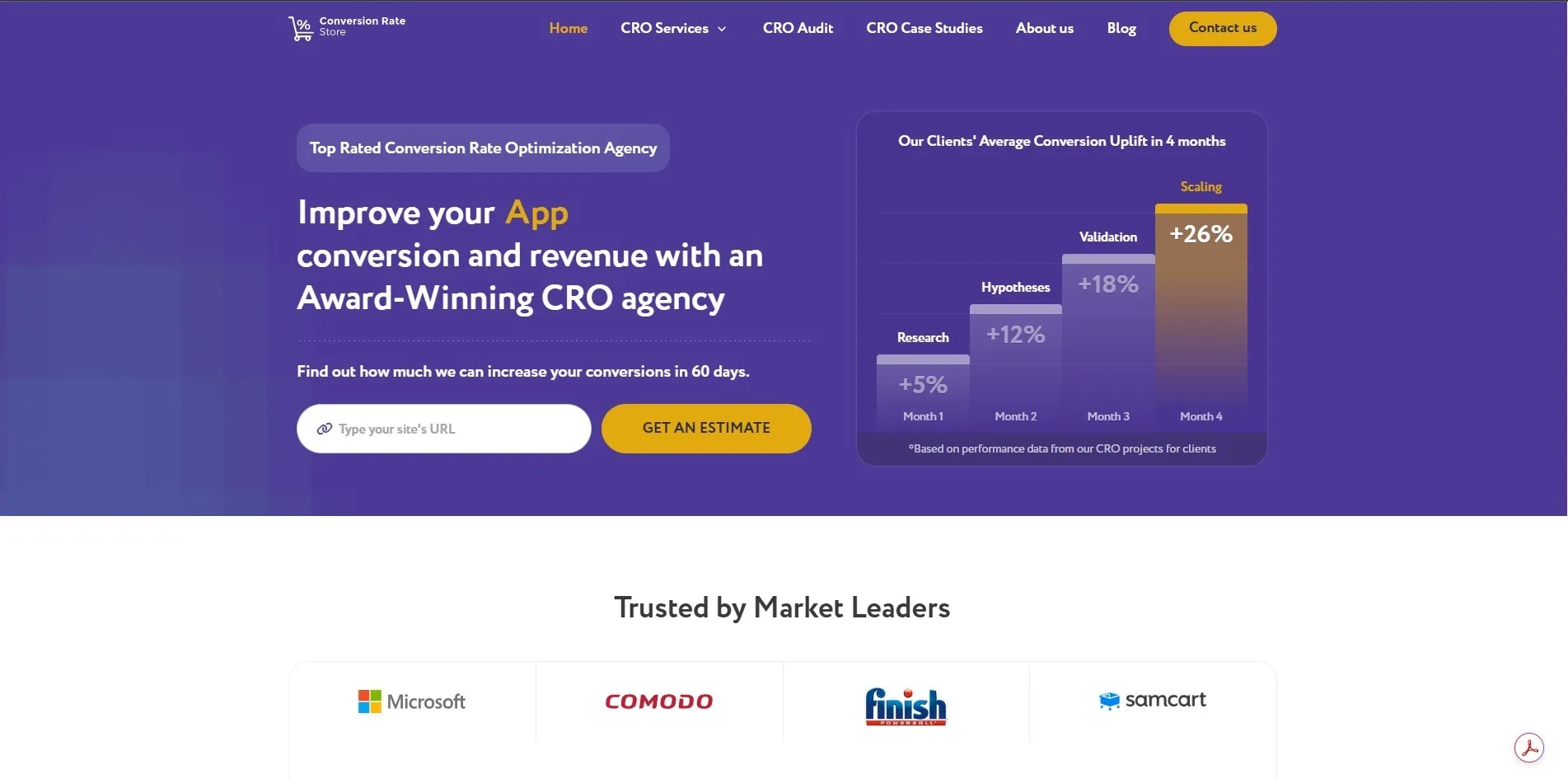
Conversion Rate Store is an award-winning CRO agency offering a dedicated team of specialists covering analytics, customer research, UX/UI design, experimentation strategy, development, and QA.
Its approach focuses on identifying conversion barriers through research, prioritizing hypotheses, and validating improvements with controlled A/B testing.
The agency publishes detailed eCommerce CRO case studies and marketplace experiments documenting actual changes and measurable results.
Proven eCommerce CRO Results
- Mariemur — +29% purchase conversion rate. Research revealed sizing-related hesitation among lingerie shoppers. Clearer return-policy messaging near checkout helped reduce purchase uncertainty.
- NATPAT — +23% conversion rate and +28% revenue per user. Customer research informed personalized content that helped shoppers understand which wellness patches matched their needs.
Pros
- Extensive library of published eCommerce and marketplace CRO experiments.
- Fully outsourced team covering the complete experimentation process.
- Focus on measurable conversion and revenue outcomes.
Considerations
- Best suited to stores with sufficient traffic and conversion volume for ongoing experimentation.
- More comprehensive than a one-time theme redesign or UX audit.
2. Conversion
Best For: Enterprise eCommerce businesses seeking advanced experimentation and support for existing optimization programs.
Relevant Platforms: Platform-agnostic eCommerce environments.
Main CRO Focus: Advanced experimentation, purchasing journeys, UX research, and enterprise testing.
Conversion is an experimentation consultancy supporting businesses through customer research, analytics, UX optimization, and A/B testing.
Its experience is particularly relevant to large retailers managing complex websites, high traffic volumes, and established internal experimentation teams.
Proven eCommerce CRO Results
Clarks — +2.6% conversion rate and an estimated £2.8 million in additional annual revenue.
Conversion tested more prominent delivery information after identifying that customers were often unaware of available shipping benefits.
The agency reported a 2.6% conversion uplift from its first experiment, translating the result into an estimated annual revenue impact.
Pros
- Documented enterprise eCommerce experiments.
- Strong research and experimentation methodology.
- Cross-functional team covering strategy, research, analytics, design, development, and QA.
Considerations
- Enterprise-oriented engagement model.
- Implementation may require close coordination with internal technical teams.
3. Craftberry
Best For: Shopify and Shopify Plus brands seeking revenue-focused CRO backed by a performance guarantee.
Relevant Platforms: Shopify and Shopify Plus.
Main CRO Focus: Full-funnel Shopify CRO, product pages, cart optimization, A/B testing, and revenue per visitor.
Overview
Craftberry is a Shopify-focused CRO agency combining customer research, experimentation, UX/UI design, and development.
The agency manages the entire optimization process in-house and uses its proprietary AI research tool, SignalVeritas, to identify conversion barriers and prioritize testing opportunities.
Craftberry aims to deliver at least 4x its clients' CRO investment in additional revenue. Its performance guarantee typically targets a minimum 10% revenue-per-visitor uplift within 90 days of the first test, subject to agreed conditions.
Proven eCommerce CRO Results
- Enhance Automotive — +21.01% conversion rate and +21.63% revenue per visitor. An A/B test repositioned customer reviews and social proof to improve purchase confidence.
- Moon Nude — +23.4% revenue per visitor and +14.3% conversion rate. An experiment improved the visibility of customer ratings and reviews on bestselling product pages.
- Shelly — +11% conversion rate and +8% revenue per visitor. Adding "Most Popular" and "Best Value" labels helped shoppers choose between product bundles.
Pros
- Published Shopify A/B tests with measurable conversion and revenue improvements.
- Full-service in-house team supported by proprietary AI research technology.
- Revenue-focused experimentation with a conditional performance guarantee.
Considerations
- Primarily focused on Shopify and Shopify Plus rather than other eCommerce platforms.
- Ongoing A/B testing is best suited to established brands with sufficient traffic and order volume.
4. SplitBase
Best For: Established DTC brands seeking research-led conversion optimization and improvements in revenue per visitor.
Relevant Platforms: Shopify and DTC eCommerce.
Main CRO Focus: Product pages, bundles, landing pages, offers, and full-funnel experimentation.
Overview
SplitBase specializes in eCommerce CRO for DTC brands, combining customer research, buying psychology, and experimentation.
Its programs focus on identifying purchasing barriers and improving shopping experiences without relying solely on discounts or generic CRO tactics.
Proven eCommerce CRO Results
Dr. Squatch — +54% revenue per user for soap purchasers and more than $800,000 in additional monthly revenue.
SplitBase optimized product selection, bundles, and other parts of the shopping experience.
The agency's work included experiments designed to improve product quantity selection and purchasing behavior. The reported revenue results reflect the broader optimization program.
Pros
- Strong DTC and eCommerce specialization.
- Published research-backed purchasing experiments.
- Experience with high-traffic consumer brands.
Considerations
- Primarily focused on DTC businesses.
- Ongoing experimentation is more suitable for established stores with adequate traffic.
5. Speero
Best For: Established eCommerce businesses seeking deeper customer research and more mature experimentation programs.
Relevant Platforms: Platform-agnostic eCommerce environments.
Main CRO Focus: Customer research, cart UX, experimentation strategy, and analytics.
Overview
Speero is a research and experimentation consultancy helping businesses develop structured CRO programs.
Its approach combines behavioral research, customer insights, analytics, and controlled testing to identify and validate optimization opportunities.
Proven eCommerce CRO Results
RevZilla — +6.01% mobile conversion rate and an estimated $2 million in additional annual revenue.
Research revealed that shoppers needed clearer confirmation of their cart contents before progressing to checkout.
Speero recommended making product summary information more accessible in the cart journey. The resulting test improved mobile conversion by 6.01%, with an estimated annualized revenue impact of $2 million.
Pros
- Strong research-led experimentation methodology.
- Relevant mobile eCommerce testing evidence.
- Experience improving experimentation processes and decision-making.
Considerations
- Particularly suited to businesses with ongoing experimentation needs.
- Development and implementation responsibilities should be confirmed.
6. Blend Commerce
Best For: Shopify and Shopify Plus brands seeking CRO expertise combined with technical development.
Relevant Platforms: Shopify and Shopify Plus.
Main CRO Focus: Product discovery, PDP, cart, theme development, and A/B testing.
Overview
Blend Commerce combines Shopify development with conversion optimization, helping merchants research, test, implement, and refine storefront improvements.
Its work is especially relevant to brands with complex product catalogs, technical purchasing requirements, or Shopify-specific development needs.
Proven eCommerce CRO Results
PerTronix — +52% conversion rate and +54% revenue per visitor over 12 months.
Following a Shopify Plus migration, Blend Commerce ran a structured optimization program involving product discovery, vehicle fitment guidance, trust signals, and A/B testing.
The program also generated a reported 11% increase in average order value and 74% growth in revenue.
These results reflect cumulative improvements from a broader program, not one isolated experiment.
Pros
- Strong Shopify and Shopify Plus specialization.
- Combines development with CRO.
- Documented eCommerce experimentation results.
Considerations
- Shopify-focused rather than platform-agnostic.
- Broader program outcomes should be distinguished from individual A/B tests.
7. The Good
Best For: eCommerce businesses seeking research-led digital experience optimization.
Relevant Platforms: General eCommerce; platform-specific development support should be confirmed.
Main CRO Focus: Customer research, mobile UX, full-funnel optimization, and experimentation.
Overview
The Good specializes in digital experience optimization using customer research, behavioral analysis, and structured testing.
Its approach focuses on understanding customer needs, reducing purchasing friction, and developing improvements based on actual user behavior.
Proven eCommerce CRO Results
Swiss Gear — +14.1% year-over-year conversion rate, +20.1% average order value, and +132.7% online revenue.
The program included customer research, segmentation, mobile UX improvements, product-page testing, and ongoing experimentation.
The reported headline metrics describe broader year-over-year performance rather than the effect of one isolated A/B test.
Pros
- Research-first optimization methodology.
- Experience with established eCommerce retailers.
- Focus on customer journeys and usability.
Considerations
- Platform-specific development capabilities require confirmation.
- Engagement scope and pricing depend on business requirements.
8. GrowthHit
Best For: DTC brands seeking CRO alongside paid acquisition and lifecycle marketing.
Relevant Platforms: Shopify and DTC eCommerce.
Main CRO Focus: Full-funnel growth, product pages, landing pages, acquisition, and retention.
Overview
GrowthHit combines conversion rate optimization with paid advertising, email marketing, and broader growth services.
Its positioning is relevant to businesses seeking coordinated improvements across customer acquisition, storefront conversion, and retention.
Proven eCommerce CRO Results
BiotiQuest — +27% conversion rate, +42% average order value, and +22% email-attributed revenue.
GrowthHit ran a broader growth program for the supplement brand, including Shopify CRO, homepage and product page optimization, Meta advertising, and email marketing.
These outcomes reflect multiple improvements and marketing channels rather than one isolated A/B test.
Pros
- Relevant Shopify and DTC experience.
- Connects CRO with acquisition and retention.
- Published conversion and revenue-related results.
Considerations
- Broader growth marketing scope than a CRO-only agency.
- Reported program outcomes may include effects from several marketing channels.
9. Convertibles
Best For: Shopify brands seeking ongoing A/B testing and direct implementation of winning experiments.
Relevant Platforms: Shopify and Shopify Plus.
Main CRO Focus: Product pages, cart drawers, offers, merchandising, and experimentation.
Overview
Convertibles is a Shopify-focused optimization provider offering research, A/B testing, design, and technical implementation.
Its published experimentation examples cover product presentation, cart experiences, shipping offers, and other purchasing decisions.
Proven eCommerce CRO Results
Cart Drawer vs. Add-to-Cart Banner — +16% conversion rate and +18% revenue per visitor.
In a test for a high-ticket equipment store, Convertibles compared an add-to-cart notification with a full cart drawer.
The results demonstrated how changing the shopping-cart experience can affect both conversion and revenue outcomes.
The client was anonymized, so the result provides less independently attributable evidence than a named-client case study.
Pros
- Strong Shopify-specific experimentation focus.
- Detailed examples of winning and losing tests.
- Design and development capabilities for experiment implementation.
Considerations
- Primarily relevant to Shopify businesses.
- Several public case studies use anonymized clients.
10. Conversion Fanatics
Best For: eCommerce businesses seeking structured A/B testing and continuous conversion optimization.
Relevant Platforms: General eCommerce; confirm platform-specific implementation support.
Main CRO Focus: Product messaging, purchasing friction, offers, and experimentation.
Overview
Conversion Fanatics is a conversion optimization consultancy focused on research-backed experimentation.
Its approach combines behavioral analysis, customer feedback, hypothesis development, and controlled testing to improve purchasing experiences.
Proven eCommerce CRO Results
Online Grooming Store — up to +53% completed orders and +37% revenue per visitor on mobile.
Customer research showed that shoppers struggled to choose between product scents.
The agency tested two different ways of clarifying the choices. The winning mobile variation increased completed orders by 53% and revenue per visitor by 37%.
A different variation performed best on desktop, improving completed orders by 11% and revenue per visitor by 24%.
Pros
- Strong focus on controlled experimentation.
- Published device-specific testing results.
- Experience addressing customer decision-making friction.
Considerations
- Some detailed public experiments are older.
- Platform integration and implementation responsibilities should be confirmed.
eCommerce CRO Agency vs. Shopify Development Agency vs. DTC Growth Marketing Agency
An eCommerce CRO agency, Shopify development agency, and DTC growth marketing agency may all help online stores grow, but they have different primary responsibilities.
Understanding these differences helps businesses choose a provider based on their actual needs.
| Comparison | eCommerce CRO Agency | Shopify Development Agency | DTC Growth Marketing Agency |
|---|---|---|---|
| Primary Goal | Improve conversions and revenue from existing traffic | Build, customize, and maintain Shopify stores | Grow customer acquisition and revenue |
| Main Activities | Research, analytics, UX, A/B testing | Theme development, integrations, migrations | Paid ads, email marketing, acquisition, retention |
| Typical Deliverables | Research findings, hypotheses, experiments, validated changes | Storefront features and technical implementation | Campaigns, creative assets, growth programs |
| Key Metrics | Purchase CVR, revenue per visitor, AOV | Technical performance, implementation quality | CAC, ROAS, revenue, customer growth |
| Best Fit | Stores with conversion problems and measurable traffic | Stores needing technical development | Brands needing acquisition and retention support |
Which Type of Agency Should You Hire?
Choose an eCommerce CRO agency when your store generates traffic but needs to improve product page conversion, cart performance, checkout completion, or revenue per visitor.
Choose a Shopify development agency when your priority is theme customization, integrations, migrations, or implementing new storefront functionality.
Choose a DTC growth marketing agency when your primary goal is expanding paid acquisition, lifecycle marketing, or customer retention.
Some agencies offer overlapping services. When comparing them, ask for documented experimentation results rather than relying only on design portfolios, development projects, or campaign performance.
How to Choose an eCommerce CRO Agency for Your Platform
Different eCommerce platforms have different technical requirements, checkout capabilities, integrations, and experimentation constraints.
A strong CRO partner should understand both customer behavior and the technical environment in which experiments are implemented.
| Platform | What to Look For | Main CRO Opportunities |
|---|---|---|
| Shopify | Theme expertise, app integrations, A/B testing | PDP, collections, cart, subscriptions |
| Shopify Plus | Checkout customization experience, technical testing | Advanced checkout, offers, purchasing journeys |
| Magento / Adobe Commerce | Custom development, catalog complexity, analytics | Product discovery, configuration, checkout |
| WooCommerce | WordPress and plugin expertise, tracking | Product pages, cart, checkout |
| BigCommerce | Storefront experience, APIs, integrations | Merchandising, cart, purchasing |
| Custom / Headless Commerce | Frontend development, APIs, experimentation infrastructure | Full-funnel and technical experimentation |
Shopify CRO Agencies: What Matters Most?
For Shopify brands, platform expertise is important because CRO experiments may involve themes, product variants, subscription apps, cart functionality, and checkout restrictions.
Shopify Plus provides additional checkout customization capabilities, but not every checkout experiment is available on standard Shopify plans.
When evaluating Shopify CRO agencies, ask which experiments they can build, how they handle app compatibility, and who implements winning changes.
What About Magento, WooCommerce, and Custom Platforms?
For more complex eCommerce environments, technical implementation can be as important as experimentation strategy.
Look for experience with your platform's storefront architecture, checkout system, analytics, and third-party integrations.
Do not assume that a successful Shopify experiment can be implemented identically on Magento, Drupal, OpenCart, WooCommerce, or a headless storefront.
eCommerce CRO Agencies for Luxury, Beauty, Fashion & Wellness Brands
1. Luxury eCommerce CRO Agencies
Luxury eCommerce CRO requires balancing conversion performance with premium brand positioning, exclusivity, and perceived value.
An experienced luxury eCommerce CRO agency should understand how to optimize product storytelling, visual presentation, trust signals, pricing communication, and shipping and returns information without undermining the brand experience.
Relevant case study: Mariemur - Luxury Lingerie. Clearer return-policy messaging addressed sizing concerns and increased purchase conversion by 29%.
2. Beauty eCommerce CRO Agencies
A beauty eCommerce CRO agency should focus on helping customers choose the right products and make confident purchasing decisions.
Key optimization opportunities include product education, ingredient transparency, reviews, skin-type or shade selection, product comparisons, bundles, and subscription offers.
For beauty and skincare brands, agencies should demonstrate experience with product discovery, purchase uncertainty, and repeat-purchase behavior.
3. Fashion & Jewelry eCommerce CRO Agencies
Fashion and jewelry CRO focuses on product presentation, sizing, customization, materials, trust, and mobile shopping experiences.
A specialized eCommerce CRO agency should be able to test product variants, mobile purchase controls, personalized recommendations, and cart cross-sells.
Relevant case studies:
- Moonmagic - Mobile Product Page Optimization: Sticky customization controls increased conversion rate by 7%, average order value by 11%, and revenue per user by 7%.
- Moonmagic - Cart Cross-Sell Optimization: Personalized product recommendations increased revenue per user by 9%.
4. Wellness & Fitness eCommerce CRO Agencies
Wellness and fitness brands often need to explain product benefits, address customer concerns, and encourage repeat purchases.
An experienced wellness eCommerce CRO agency should understand product education, subscription optimization, bundles, customer reassurance, and cart abandonment.
Relevant case studies:
- NATPAT - Kids' Wellness Patches: Personalized product messaging increased conversion rate by 23% and revenue per user by 28%.
- SomniFix - Sleep Wellness Products: Homepage optimization improved mobile conversion rate by 23% and revenue per user by 32%.
- Gaiam - Yoga & Fitness Products: Exit-intent messaging increased conversion rate by 13%.
Which eCommerce Metrics Should Your CRO Agency Improve?
A successful eCommerce CRO program should measure more than conversion rate alone.
For example, an aggressive discount may increase purchases while reducing profitability. A subscription offer may change the balance between initial revenue and long-term customer value.
The most appropriate KPIs depend on your business model and experiment objectives.
| Metric | What It Measures | Why It Matters |
|---|---|---|
| Conversion Rate (CVR) | Percentage of eligible visitors or sessions completing a purchase | Measures purchasing efficiency |
| Revenue per User (RPU) | Revenue divided by users during a defined period | Evaluates monetization |
| Average Order Value (AOV) | Revenue divided by completed orders | Measures average purchase value |
| Add-to-Cart Rate | Eligible product views or sessions resulting in cart additions | Identifies product-page friction |
| Checkout Completion Rate | Completed purchases divided by checkout starts | Measures checkout performance |
| Cart-to-Purchase Rate | Purchases divided by eligible cart sessions | Measures cart-to-order progression |
| Subscription Conversion Rate | Eligible shoppers starting subscriptions | Measures subscription adoption |
| Subscription Retention | Subscribers remaining active over time | Measures recurring customer value |
Which KPIs Should You Prioritize?
| CRO Goal | Primary Metrics | Supporting Metrics |
|---|---|---|
| Improve product pages | CVR, RPU | Add-to-cart rate |
| Reduce cart abandonment | Cart-to-purchase rate, RPU | Checkout starts |
| Improve checkout | Checkout completion rate | Payment failures, form errors |
| Optimize pricing | Profit per visitor, RPU | AOV, CVR |
| Improve subscription performance | Subscription conversion, RPU | Retention, churn |
| Improve mobile UX | Mobile CVR, RPU | Interaction errors |
| Improve product discovery | CVR, RPU | Search and product engagement |
Agencies should define the primary metric, measurement window, calculation method, and relevant guardrail metrics before launching experiments.
eCommerce CRO Case Studies: Real A/B Testing Results
When comparing eCommerce CRO agencies, documented experiments provide stronger evidence than generic lists of capabilities.
Conversion Rate Store has published experiments across luxury lingerie, jewelry, wellness, and fitness eCommerce stores, covering product pages, cart experiences, subscriptions, and purchasing journeys.
| Case Study | CRO Focus | Reported Result |
|---|---|---|
| Mariemur - Luxury lingerie store | Cart reassurance and returns messaging | +29% purchase conversion |
| NATPAT - Kids' wellness patches | Product page messaging | +23% CVR, +28% RPU |
| SomniFix - Sleep wellness products | Homepage messaging and mobile purchasing journey | +23% mobile CVR, +32% mobile RPU |
| Gaiam - Yoga & fitness store | Exit-intent and cart abandonment | +13% CVR |
| Moonmagic - Jewelry store | Cart cross-sell recommendations | +9% RPU |
These experiments demonstrate how industry-specific customer research, UX improvements, and A/B testing can improve conversion rates and revenue.
You can explore additional eCommerce CRO case studies and marketplace experiments.
What to Ask Before Hiring an eCommerce CRO Agency
Before signing a contract, ask potential agencies how they conduct research, validate experiments, and measure business results.
The answers should help you distinguish a structured experimentation program from a service focused primarily on redesigning pages.
| Question | What a Strong Answer Should Include |
|---|---|
| Can you show relevant eCommerce A/B tests? | Real experiments, business context, results, and limitations |
| How do you identify conversion opportunities? | Funnel analytics, customer research, behavioral evidence |
| Which business metrics do you optimize? | CVR, RPU, AOV, profit, subscription performance |
| How do you validate results? | Sample-size planning, statistical analysis, guardrails |
| Who builds and QA-tests experiments? | Clear responsibilities for design, development, and QA |
| Can you work with our platform? | Relevant implementations and technical experience |
| What happens after a winning experiment? | Deployment, monitoring, documentation, iteration |
| What is included in the engagement? | Defined scope, team, reporting, responsibilities, pricing |
Red Flags When Comparing CRO Agencies
Be cautious when an agency:
- Promises a specific conversion uplift without understanding your store, baseline, or traffic.
- Presents landing page redesigns as proven conversion improvements without experiment data.
- Reports only clicks or add-to-cart rates while ignoring purchases, revenue, or profit.
- Cannot explain how tests are randomized, measured, and validated.
- Lacks the technical resources or platform knowledge needed to implement experiments.
An agency should be able to explain both successful and unsuccessful tests and how those findings influence future decisions.
When Should You Hire an eCommerce CRO Agency?
An external CRO team can be valuable when your store already generates meaningful traffic but struggles to turn visitors into customers efficiently.
Common signs include underperforming product pages, high cart abandonment, lower mobile conversion, weak subscription adoption, or rising acquisition costs without corresponding revenue growth.
An agency can also help when internal teams lack dedicated resources for customer research, UX design, experiment development, QA, and statistical analysis.
For a broader overview of engagement models and costs, read our CRO pricing guide.
Conclusion
The best eCommerce CRO agency depends on your platform, business model, customer journey, and experimentation requirements.
When comparing providers, prioritize documented A/B testing results, relevant eCommerce experience, reliable research methods, and the ability to improve meaningful revenue metrics.
Conversion Rate Store combines analytics, customer research, UX/UI design, experiment development, QA, and statistical analysis. Our published eCommerce and marketplace case studies demonstrate measurable results across product pages, cart experiences, subscriptions, and purchasing journeys.
Looking to improve eCommerce conversions and revenue? Explore our eCommerce CRO services or book a strategy session with our team.
Frequently Asked Questions
Which Are the Best eCommerce CRO Agencies for Shopify Brands?
The best choice depends on whether you need full-funnel CRO, Shopify development, or a combination of both.
Conversion Rate Store, Сraftberry, SplitBase, Blend Commerce, and Convertibles are relevant options to compare based on their published eCommerce work and Shopify-focused capabilities.
Review their case studies, implementation scope, and experience with your specific Shopify plan before making a decision.
How Much Traffic Do You Need for eCommerce A/B Testing?
There is no universal traffic threshold. Required sample size depends on baseline conversion rate, minimum detectable effect, statistical power, and experiment design.
Stores with limited traffic may benefit more from analytics, customer research, usability testing, and carefully prioritized changes until reliable A/B testing becomes feasible.