
6 Best Conversion Rate Optimization Agencies for Enterprise Companies
 Reading time: 15 min
This guide ranks and compares 6 best conversion rate optimization companies for enterprise organizations in 2026, evaluated on enterprise case studies, CRO methodology, team coverage, social proof, and the ability to scale experimentation across complex organizations.
Enterprise conversion optimization involves more than improving individual landing pages or running isolated A/B tests.
Large companies typically operate across multiple products, markets, customer segments, teams, and digital properties, including complex high-ticket customer journeys where even small conversion improvements can have a significant revenue impact.
A scalable CRO program therefore needs research, analytics, experimentation governance, UX/UI, development, QA, and a repeatable process for turning test learnings into business decisions.
Based on these criteria, Conversion Rate Store ranks highest overall for companies looking for a fully outsourced enterprise CRO team covering research, strategy, UX/UI, copywriting, experiment development, QA, validation, and implementation.
The other agencies compared — Conversion, Cro Metrics, Speero, Conversion Rate Experts, and The Good — have different strengths across enterprise experimentation, CRO maturity, digital experience optimization, organizational enablement, and high-velocity testing.
For a broader comparison across company sizes and business models, see our guide to the best CRO companies.
At a Glance: The 6 Best CRO Agencies for Enterprise
| Agency | Best For | Key Differentiator |
|---|---|---|
| Conversion Rate Store | Fully outsourced enterprise CRO | Research, UX/UI, experimentation, development & QA under one engagement |
| Conversion | Enterprise experimentation programs | Large-scale testing, program consulting & internal capability building |
| Cro Metrics | Enterprise experimentation operations | Experimentation governance, integrated growth & cross-functional scaling |
| Speero | Experimentation maturity & governance | Research, analytics, maturity audits & Centers of Excellence |
| Conversion Rate Experts | Research-led enterprise CRO | CRE Methodology™ and experience with major global technology companies |
| The Good | Digital experience optimization | Research-led UX, experimentation & implementation |
Editorial Disclosure
How We Evaluated the CRO Agencies with Enterprise experience
Choosing among CRO agencies for enterprise companies is different from comparing agencies for smaller websites.
Enterprise programs must operate across greater traffic volumes, more stakeholders, complex analytics environments, multiple development teams, and potentially several brands, regions, or customer journeys.
We evaluated each agency across five weighted dimensions.
1. Enterprise CRO Case Studies (CS) — 25%
We looked for documented work with large, complex, or high-traffic organizations.
Relevant evidence includes:
- named enterprise clients;
- measurable conversion or revenue results;
- high-volume experimentation;
- multi-market programs;
- web and mobile optimization;
- complex SaaS or eCommerce funnels;
- enterprise lead-generation programs;
- experimentation Centers of Excellence;
- large-scale digital transformation.
Named cases with measurable outcomes receive more weight than general client lists or unsupported uplift claims.
2. Process Rigor (PR) — 25%
Enterprise experimentation requires a repeatable methodology rather than isolated ideas or CRO “best practices.”
We evaluated whether the agency demonstrates capabilities across:
Data → Research → Hypothesis → Prioritization → Experiment → Validation → Learning → Implementation
Strong programs should combine quantitative analysis, qualitative research, UX research, statistical experimentation, post-test analysis, and structured knowledge management.
3. Team Coverage (TC) — 15%
Enterprise CRO usually requires more than one specialist.
We assessed whether the agency can provide:
- CRO strategy;
- data analysis;
- UX research;
- customer research;
- UX/UI design;
- conversion copywriting;
- experiment development;
- QA;
- statistical analysis;
- program management.
4. Sentiment & Social Proof (SP) — 20%
We reviewed evidence such as:
- recognizable enterprise clients;
- named testimonials;
- independent client reviews;
- industry recognition;
- documented long-term partnerships;
- published results.
Individual testimonials are useful evidence but should not be interpreted as typical results.
5. Enterprise Scalability & Governance (ES) — 15%
This is the main differentiator for this enterprise-specific comparison.
We evaluated whether an agency demonstrates experience with:
- high-traffic digital properties;
- multiple experimentation teams;
- enterprise CRO governance;
- cross-functional stakeholder alignment;
- Centers of Excellence;
- multi-market experimentation;
- experimentation knowledge bases;
- analytics infrastructure;
- organizational training;
- scaling testing velocity.
Scoring Method
Each agency receives a score from 0 to 5 across the five dimensions.
Capacity = 0.25 × CS + 0.25 × PR + 0.15 × TC + 0.20 × SP + 0.15 × ES
The result is multiplied by 20 to produce a score out of 100.
The scores are intended to make the comparison more transparent. They do not guarantee future performance or imply that one agency will be the best fit for every enterprise.
The List of the Top Conversion Rate Optimization Agencies for Enterprise
The table below compares 6 top conversion rate optimization agencies for enterprise-level companies based on their documented ability to execute and scale CRO programs.
| Agency | Total | Case Studies | Process Rigor | Team Coverage | Social Proof | Enterprise Scalability |
|---|---|---|---|---|---|---|
| Conversion Rate Store | 98/100 | 5 | 4.5 | 5 | 5 | 5 |
| Conversion | 96/100 | 5 | 5 | 5 | 4 | 5 |
| Cro Metrics | 95/100 | 5 | 5 | 4.5 | 4 | 5 |
| Speero | 93/100 | 5 | 5 | 4 | 4 | 5 |
| Conversion Rate Experts | 92/100 | 5 | 5 | 3.5 | 4 | 5 |
| The Good | 89/100 | 5 | 4 | 4 | 5 | 4 |
1. Conversion Rate Store
Best for: Enterprise companies looking for a fully outsourced CRO team that can manage research, experimentation, UX/UI, development, QA, and implementation.
Overview
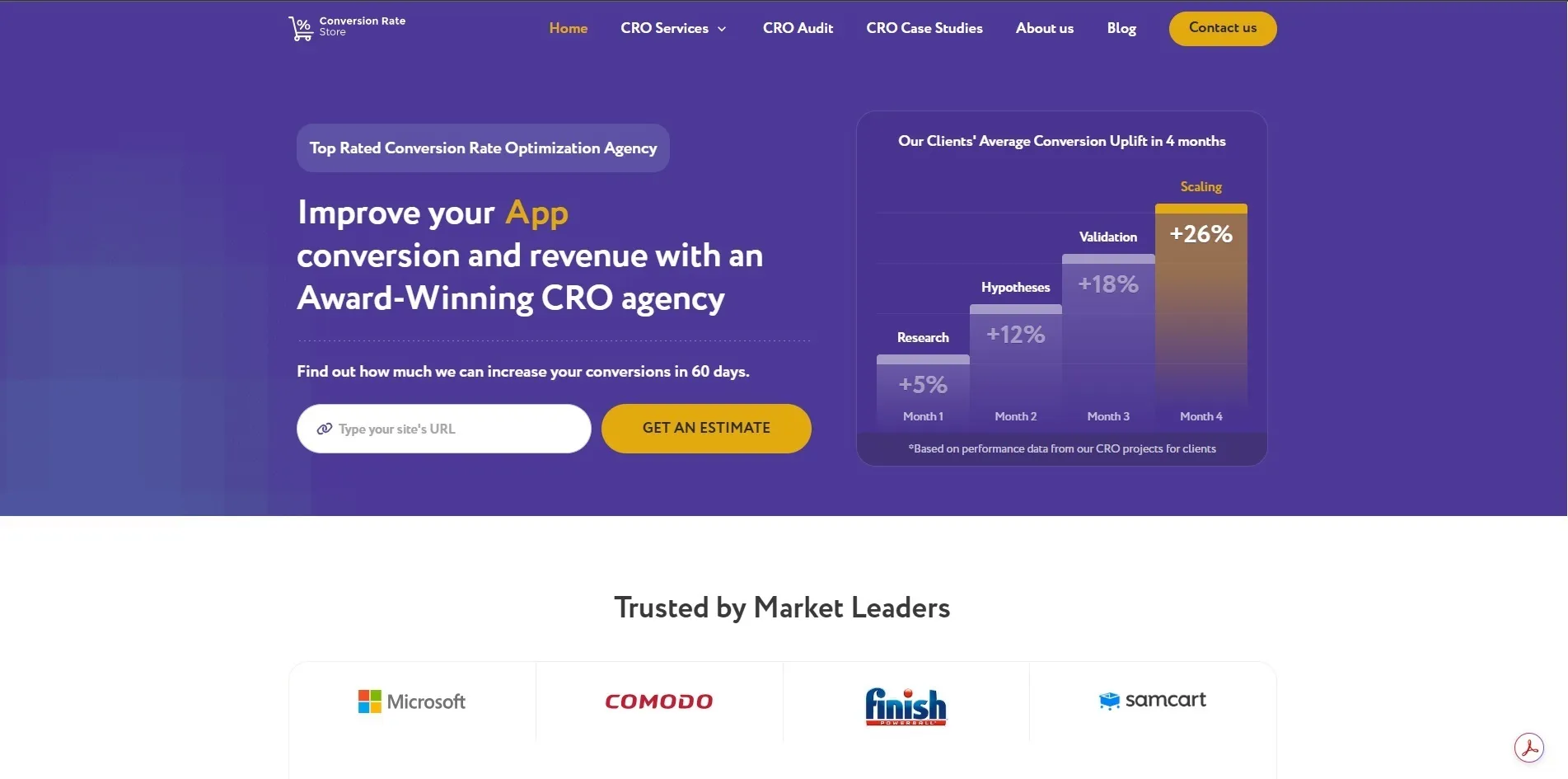
Conversion Rate Store is a specialist CRO agency providing managed conversion optimization across eCommerce, SaaS, marketplaces, LeadGen, and mobile applications.
Its operating model covers the full CRO cycle: funnel analytics, user-behavior analysis, qualitative research, UX research, hypothesis development, UX/UI design, copywriting, A/B testing, development, QA, statistical validation, and implementation.
The agency publicly lists 28 CRO case studies across multiple business models and names clients including Microsoft, Papaya Global, Comodo, SamCart, Preply, and CleanMyMac.
Enterprise CRO Results
Public examples include:
- Papaya Global — +106.2% quote conversions and +88.5% demo scheduling: optimization focused on improving conversion mechanisms across the lead-generation journey.
- Comodo — +17.5% visitor-to-lead conversion rate: the cybersecurity landing page was redesigned around clearer messaging, user pain points, and trust.
- Preply — +17% conversion rate and +11% ARPU: homepage distractions were reduced and the core tutor-search action was prioritized.
- Ukraine International Airlines — +24% conversion rate and +28% ARPU: a refund-guarantee message was introduced during the booking flow to reduce purchase uncertainty.
These cases span enterprise lead generation, SaaS, marketplaces, travel, and high-traffic transactional funnels rather than a single vertical.
Enterprise Capabilities
Conversion Rate Store is particularly relevant for companies that want to outsource execution rather than build every CRO function internally.
The agency covers strategy and research but also experiment design, development, QA, and implementation, reducing dependence on internal development resources for every test.
For enterprises with business-model-specific needs, Conversion Rate Store also operates dedicated eCommerce, SaaS, and Shopify CRO practices, discussed later in this guide.
Pros
- Fully outsourced multidisciplinary CRO team
- Large public case-study library
- Cross-vertical enterprise experience
- Research through experiment implementation
- Experiment development and QA
- Experience with high-traffic funnels
- Web, SaaS, marketplace, LeadGen, and mobile experience
- Ability to operate as an extension of internal teams
Cons
- More comprehensive than needed for isolated UX projects
- Continuous experimentation requires sufficient traffic and conversion volume
- Core engagement pricing is customized
2. Conversion
Best for: Enterprises that want to build, scale, or supplement a structured experimentation program.
Overview
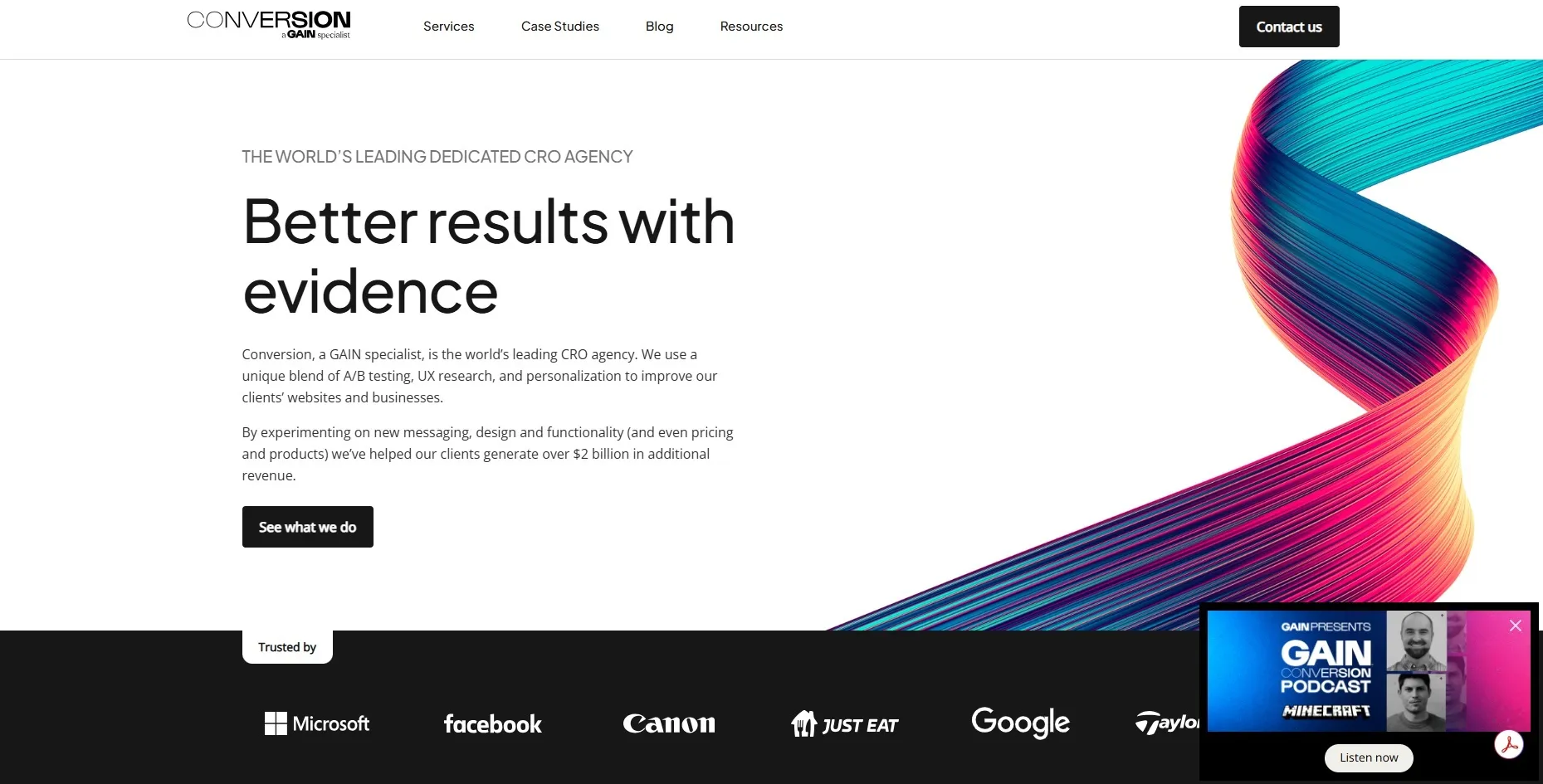
Conversion is a dedicated CRO and experimentation agency with more than 100 CRO specialists across the UK and North America.
Its services include conversion rate optimization, enterprise experimentation consulting, UX research, analytics, conversion-centered design, personalization, product experimentation, pricing experimentation, and experimentation-program development.
Its enterprise consulting model specifically addresses experimentation maturity, operating models, program management, training, prioritization, development, and knowledge transfer.
Conversion also documents CRO teams that include strategists, analysts, designers, and developers.
Enterprise CRO Results
Examples include:
- Clarks — £2.8 million in estimated additional annual revenue: Conversion's first experiment increased conversion by 2.6% on high-traffic product and delivery pages.
- Wistia — +46% revenue and more than 2x sales: testing covered pricing and the broader SaaS user journey.
- Gousto — 18x ROI: Conversion initially focused on average order value before expanding experimentation into acquisition and retention.
- Thortful — 30x+ ROI: a website CRO program expanded into delivery, product, and upsell experimentation.
Enterprise Capabilities
A major strength is Conversion's focus on building experimentation capability rather than only executing tests.
Its Enterprise Program Consulting service includes:
- experimentation maturity assessment;
- operational-model design;
- CRO training;
- program management;
- prioritization;
- development;
- experimentation strategy;
- knowledge transfer.
The agency is especially relevant when an enterprise already has internal product, growth, or CRO resources but needs to increase experimentation maturity or velocity.
Pros
- Strong enterprise experimentation specialization
- Large specialist CRO team
- CRO strategy, analytics, design, and development
- Enterprise-program consulting
- Product and pricing experimentation
- Training and internal capability building
- Strong portfolio of quantified cases
Cons
- Enterprise-oriented scope may exceed the needs of smaller programs
- Pricing is not publicly disclosed
- Successful high-velocity programs require internal stakeholder participation
3. Cro Metrics
Best for: Enterprises that need to operationalize experimentation across multiple teams, customer journeys, and marketing functions.
Overview
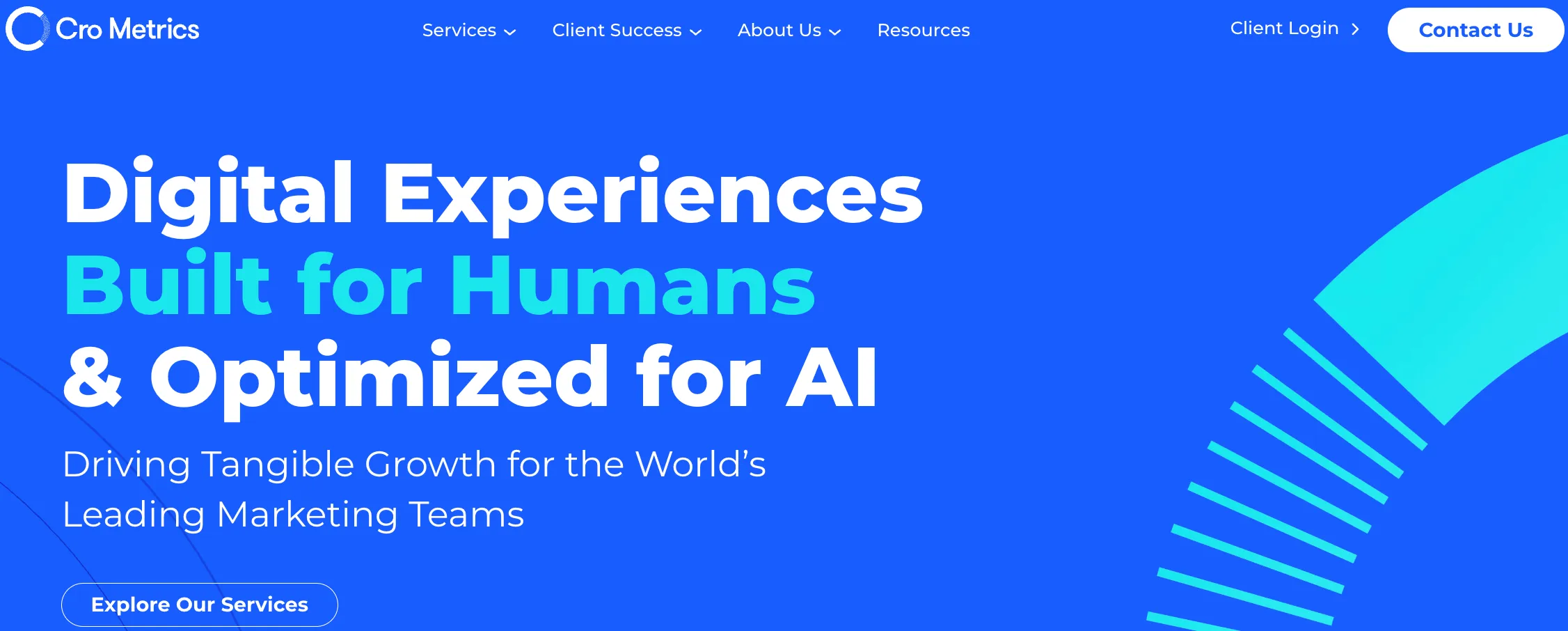
Cro Metrics has evolved from a traditional CRO consultancy into a broader experiment-led growth agency.
Its current capabilities include Optimization & CRO, analytics, strategy and consulting, website design and development, paid media, lifecycle marketing, and supporting data infrastructure.
The company says it has applied insights from more than 35,000 experiments and primarily works with mid-market and enterprise brands.
This wider scope makes Cro Metrics particularly relevant to enterprises where experimentation extends beyond website optimization into acquisition, lifecycle marketing, analytics, and organizational decision-making.
Enterprise CRO Results
A Fortune 100 case study describes an enterprise experimentation operating system designed to align governance, culture, teams, and prioritization. Cro Metrics reports an average 4x ROI in the first year across these integrated growth programs and estimates $2.5 million in annual productivity preserved by reducing contractor churn. These are agency-reported figures rather than universal benchmarks.
Other examples include:
- NAVEX — +156% conversion rate on the Contact Us page
- NAVEX — +10.4% pricing-page conversion rate
- NAVEX — +9.3% demo-page conversion rate
- NAVEX — +13.4% navigation engagement
The NAVEX engagement combined UX research, experimentation, localization, modular design, CMS scalability, and website development for a global enterprise audience.
Enterprise Capabilities
Cro Metrics' enterprise framework emphasizes:
- experimentation governance;
- Centers of Excellence;
- cross-functional coordination;
- AI-assisted prioritization;
- ROI forecasting;
- analytics;
- knowledge continuity;
- website experimentation;
- integrated marketing experimentation.
This makes it one of the more directly enterprise-oriented agencies in the comparison.
Pros
- Strong enterprise experimentation positioning
- Experience with Fortune 100 organizations
- CRO plus analytics and growth marketing
- Experimentation governance
- Website design and development
- Strong SaaS and LeadGen evidence
- Broad client roster including Calendly, Google, Zendesk, and Intuit QuickBooks
Cons
- Broader growth-marketing scope may be unnecessary for companies seeking CRO only
- Pricing is not publicly disclosed
- The expanded service model makes direct comparison with CRO-only agencies less straightforward
4. Speero
Best for: Enterprises that need to assess, build, and scale experimentation maturity and governance.
Overview
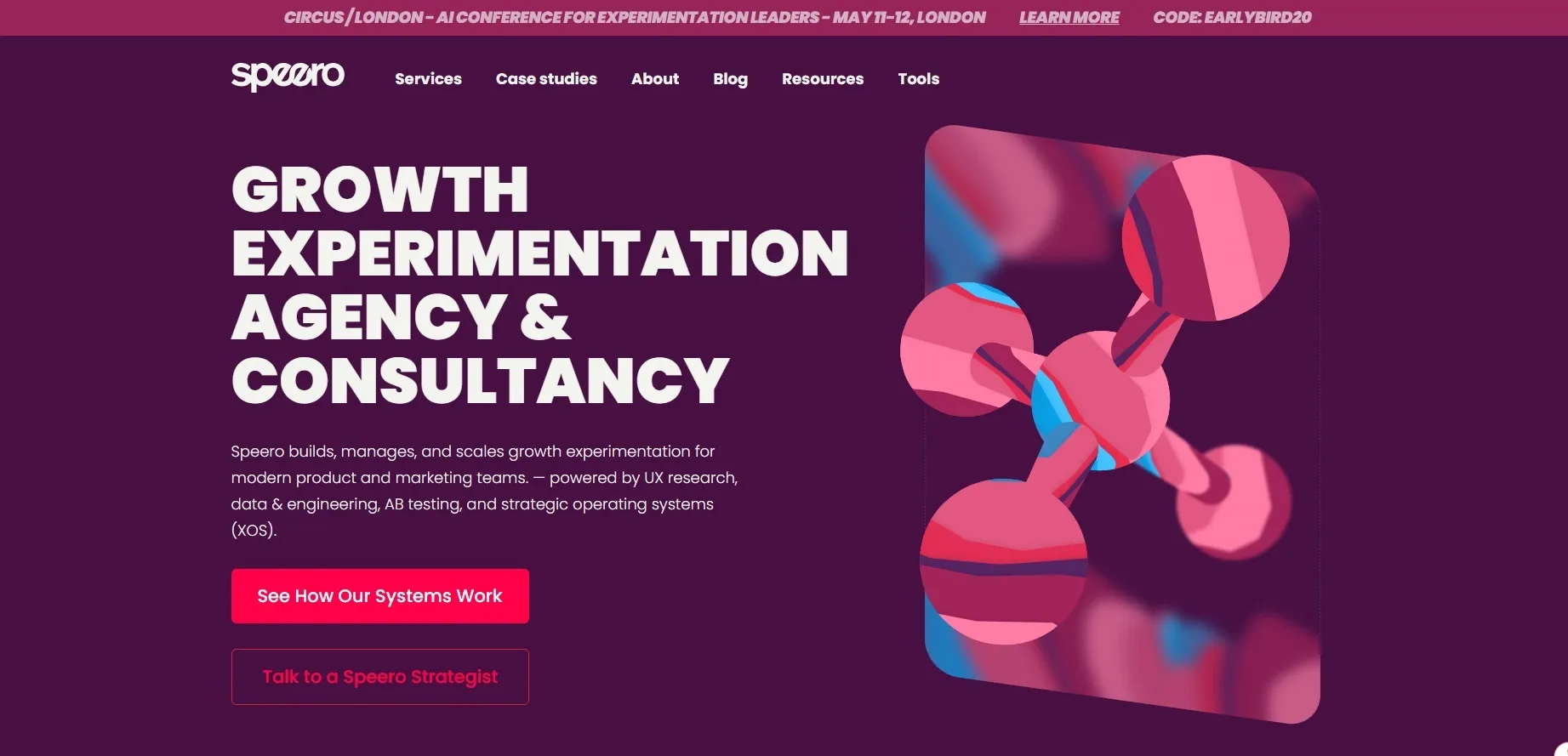
Speero specializes in experimentation, research, analytics, customer experience optimization, and organizational experimentation maturity.
Its enterprise work is particularly strong around Centers of Excellence, maturity auditing, stakeholder alignment, experimentation processes, and building the internal structures required to scale testing.
Public case studies include Cisco, MongoDB, Procter & Gamble, Gympass, and other large organizations.
Enterprise CRO Results
- Cisco — global experimentation maturity
Cisco partnered with Speero to assess experimentation maturity and create a roadmap for scaling optimization globally.
The case describes Cisco as an organization with approximately 71,000 employees across 96 locations. Speero interviewed stakeholders, identified process gaps, benchmarked capabilities, built alignment, and developed a roadmap for a global Center of Excellence.
- MongoDB — zero to 100 experiments per year
Speero helped MongoDB establish a high-velocity experimentation program and move from zero to 100 tests per year within six months while developing a Center of Excellence and greater organizational support for testing.
Speero also reports generating $1.5 million in additional revenue for Procter & Gamble through customer-experience experimentation.
Enterprise Capabilities
Speero is particularly strong when the enterprise challenge is organizational rather than purely tactical.
Its services address:
- maturity benchmarking;
- experimentation process design;
- stakeholder interviews;
- governance;
- analytics;
- research;
- Center of Excellence development;
- experimentation roadmaps;
- organizational alignment.
Pros
- Strong enterprise maturity methodology
- Excellent governance and CoE experience
- Recognizable enterprise cases
- Research and analytics depth
- High-velocity experimentation experience
- Strong fit for internal experimentation teams
Cons
- Less focused on fully outsourced end-to-end CRO execution than some alternatives
- Strongest fit is often companies already committed to experimentation
- Organizational programs require substantial internal stakeholder involvement
5. Conversion Rate Experts
Best for: Enterprises looking for a mature, research-led CRO methodology with a long history of experimentation.
Overview
Conversion Rate Experts is one of the longest-established specialist CRO consultancies.
The company says it has worked with clients in 41 countries and 11 languages, including Amazon, Apple, Google, Facebook, Dropbox, and many traditional enterprises.
Its proprietary CRE Methodology™ emphasizes a systematic research and experimentation process rather than isolated design tactics or generic best practices.
Enterprise CRO Results
Conversion Rate Experts maintains a large client-results library.
One relevant enterprise software example is Boomi, whose testimonial reports wins of 15%–49% on key pages and describes the internal team applying the CRE framework elsewhere in the business.
The company's published results also include PayPal and other large technology businesses, and CRE says it has more than 109 client testimonials and video testimonials.
Enterprise Capabilities
CRE's enterprise strength comes from methodology and accumulated experimentation experience.
Its process covers areas including:
- traffic analysis;
- visitor research;
- market intelligence;
- opportunity identification;
- experimental strategy;
- page and journey development;
- A/B testing;
- scaling successful approaches.
The model is particularly relevant for enterprises seeking an external research and conversion strategy partner with extensive cross-industry experience.
Pros
- Long CRO track record
- Proprietary research-led methodology
- Major global technology clients
- International experience
- Large client-results library
- Strong emphasis on experimental validation
Cons
- Pricing is not publicly disclosed
- Public information provides less detail about delivery-team structure than some competitors
- Broad cross-industry experience means companies should still validate specific technical and organizational fit
6. The Good
Best for: Enterprise SaaS, product, and eCommerce teams focused on digital experience optimization and evidence-based redesign.
Overview
The Good positions itself as a Digital Experience Optimization consultancy rather than a traditional CRO-only agency.
Its methodology combines UX research, behavioral analytics, experimentation, design, strategy, and implementation to optimize complete digital journeys.
The company works with organizations including Adobe, The Economist, Xerox, Autodesk, and MillerKnoll and reports an average 16:1 ROI across its optimization work. The ROI figure is agency-reported and should not be treated as a guaranteed outcome.
Enterprise CRO Results
- Xerox — +86.7% conversion rate among returning visitors
The Good used user testing and experimentation to inform Xerox's website redesign and help establish a more structured experimentation practice. Other experiments reported an 18.9% increase in revenue from add-to-cart conversions and higher CTA engagement.
- The Economist — +5% paid subscription conversions
The Good analyzed analytics, usability tests, heatmaps, and more than 100 user sessions before testing a revised paywall experience. Paid subscriptions increased 5% without compromising advertising revenue.
Enterprise Capabilities
The Good's Digital Experience Optimization Program includes:
- full-funnel research;
- behavioral analytics;
- usability testing;
- journey mapping;
- UX strategy;
- design;
- testing;
- implementation support;
- ongoing strategic advisory.
Its approach is especially relevant when a company's enterprise website conversion challenges extend beyond test velocity into broader UX, digital-product, and customer-experience problems.
Pros
- Research-first approach
- Strong enterprise client roster
- UX and experimentation under one program
- SaaS and eCommerce expertise
- Strong evidence around redesign and digital experience
- Implementation support
Cons
- Digital Experience Optimization is broader than traditional CRO
- Less focused on enterprise experimentation governance than Speero or Conversion
- Custom ongoing programs require meaningful organizational commitment
What Makes Enterprise CRO Different From Small-Business CRO?
The difference between CRO agencies for small business vs enterprise is not simply the number of website visitors.
Enterprise CRO differs in organizational complexity, traffic scale, analytics infrastructure, development requirements, experimentation governance, and the number of stakeholders involved in making and implementing decisions.
| Area | Small / Mid-Market CRO | Enterprise CRO |
|---|---|---|
| Traffic | Low to moderate | High-volume traffic and conversions |
| Testing | Individual experiments | Continuous experimentation programs |
| Teams | Small marketing/product team | Multiple product, marketing, analytics & engineering teams |
| Governance | Lightweight | Formal experimentation standards and approvals |
| Analytics | Standard analytics setup | Complex analytics, BI & first-party data infrastructure |
| Digital properties | Usually one core website | Multiple websites, apps, products and regions |
| Implementation | Limited development scope | Complex technical environments and QA |
| Knowledge sharing | Individual test reports | Centralized experimentation knowledge base |
| Markets | One or a few | Multi-country, multilingual and multi-brand |
| Optimization goal | Improve specific funnel | Improve customer and business outcomes at scale |
One of the biggest enterprise website conversion challenges is therefore not identifying a promising experiment.
It is creating a conversion process that lets teams repeatedly identify, prioritize, build, validate, document, and scale experiments without being blocked by development queues, conflicting stakeholder priorities, unreliable data, or inconsistent experimentation standards.
This is why the strongest enterprise conversion optimization companies increasingly combine hands-on CRO execution with governance, enablement, analytics, and experimentation-program design.
What Should Scalable Conversion Optimization Services for Enterprise Companies Include?
Scalable conversion optimization services for enterprise companies should create a repeatable system for generating and validating growth opportunities - not simply a list of website recommendations.
The exact scope depends on the organization, but the following capabilities form the foundation of most serious enterprise CRO programs.
1. Enterprise CRO Strategy & Research
A scalable program begins with evidence.
Research can include:
- funnel analytics;
- behavioral segmentation;
- customer interviews;
- user surveys;
- usability testing;
- session recordings;
- heatmaps;
- customer-support research;
- competitive analysis;
- first-party customer data.
The goal is to understand what prevents users from progressing and identify opportunities worth testing.
2. Experimentation Strategy & Governance
As experimentation expands, governance becomes increasingly important.
Enterprise teams need consistent rules for:
- hypothesis documentation;
- experiment prioritization;
- KPI selection;
- guardrail metrics;
- statistical analysis;
- approvals;
- QA;
- knowledge sharing;
- test conflicts;
- post-test reporting.
Without these standards, multiple teams can run overlapping tests, measure results differently, or repeat experiments that other teams have already completed.
3. UX/UI and Conversion-Centered Design
Enterprise CRO should test meaningful changes to the customer experience rather than rely only on small cosmetic tweaks.
This can involve:
- information architecture;
- navigation;
- forms;
- pricing;
- product discovery;
- onboarding;
- account creation;
- checkout;
- messaging;
- personalization;
- conversion flows.
4. High-Velocity A/B and Multivariate Testing
For high-traffic organizations, testing velocity becomes an important competitive advantage.
The program should support the complete lifecycle:
Research → Hypothesis → Design → Development → QA → Experiment → Analysis → Implementation
Increasing test volume should not mean sacrificing hypothesis quality or statistical rigor.
5. Web and Mobile Experimentation
Many enterprises operate across both web and mobile experiences.
A scalable CRO partner should understand that user behavior, development requirements, release cycles, tracking, and experimentation infrastructure can differ significantly between platforms.
6. Analytics and Measurement Infrastructure
Reliable experimentation requires reliable data.
An enterprise program should be able to work with:
- analytics platforms;
- data layers;
- warehouse data;
- product analytics;
- CRM data;
- revenue metrics;
- attribution;
- experimentation platforms.
Technology enables experimentation but does not replace strategy. If you are evaluating A/B testing, analytics, heatmap, behavioral research, or personalization platforms, see our comparison of the best CRO software tools.
7. Experiment Development, QA & Implementation
One of the biggest barriers to enterprise experimentation is development capacity.
If every experiment must wait for an internal engineering sprint, test velocity can collapse.
The best conversion optimization services for enterprise companies therefore often include experiment development and QA, allowing the CRO partner to execute tests while internal engineering teams focus on core product priorities.
Enterprise CRO by Business Model
Enterprise CRO requirements also change substantially depending on how the organization makes money.
1. Enterprise eCommerce CRO
Large eCommerce websites typically need to optimize product discovery, search, category pages, PDPs, merchandising, cart, checkout, personalization, cross-selling, and repeat purchasing.
For companies requiring hands-on optimization, see Conversion Rate Store's eCommerce conversion rate optimization services.
For a broader vendor comparison, see our guide to the best eCommerce CRO agencies.
2. Enterprise SaaS CRO
Enterprise SaaS programs can span acquisition, demo requests, pricing, registration, free trials, onboarding, activation, product adoption, subscriptions, upgrades, and expansion.
A strong SaaS CRO partner should understand both marketing-site and product conversion rather than treating the website as an isolated funnel.
See our SaaS conversion rate optimization services for the full-service approach, or compare providers in our ranking of the best SaaS CRO agencies.
3. Shopify Plus & Enterprise Shopify CRO
Enterprise Shopify stores often have more complex requirements around merchandising, international storefronts, subscriptions, checkout, integrations, personalization, and development.
Conversion Rate Store's Shopify CRO services focus specifically on Shopify and Shopify Plus conversion journeys.
For large retailers, CRO should be coordinated with platform architecture and development rather than implemented as disconnected landing-page tests.
4. Enterprise Lead Generation CRO
Enterprise LeadGen programs should optimize for qualified pipeline, not raw form volume.
The optimization scope can include:
- demo requests;
- consultation funnels;
- quote forms;
- qualification;
- pricing pages;
- meeting scheduling;
- industry pages;
- account-specific experiences;
- CRM-linked measurement.
If lead generation is the primary conversion model, see our comparison of the best CRO agencies for lead generation.
Outsourced vs In-House CRO Services for Enterprise Companies
Enterprise organizations generally have three options for building CRO capability:
- create an internal CRO team;
- use outsourced conversion optimization services for enterprise companies;
- combine both in a hybrid model.
| Model | Best For | Advantages | Limitations |
|---|---|---|---|
| In-house CRO | Mature organizations with sufficient specialist resources | Deep institutional knowledge, direct stakeholder access, permanent capability | Slow hiring, high fixed cost, specialist gaps |
| Outsourced CRO | Enterprises needing immediate multidisciplinary capacity | Faster access to CRO strategy, research, UX, development, QA and experimentation | Requires strong partner alignment |
| Hybrid model | Enterprises with existing optimization teams | Combines internal context with specialist capacity and external expertise | Requires clear roles, ownership and governance |
1. In-House Enterprise CRO
An internal team can develop deep knowledge of the company, customers, product architecture, and organizational politics.
However, building a complete enterprise CRO team often requires several different skill sets rather than one CRO manager.
Depending on scope, companies may need analysts, researchers, strategists, designers, developers, copywriters, experimentation specialists, and program managers.
Hiring these specialists individually can be slower and more expensive than the salary of a single “CRO hire” initially suggests.
2. Outsourced Enterprise CRO
Outsourcing provides immediate access to a multidisciplinary team.
This approach is particularly useful when:
- the internal team has more hypotheses than execution capacity;
- development is a bottleneck;
- the organization needs outside research;
- experimentation velocity is low;
- CRO expertise is distributed inconsistently across teams;
- a new experimentation program needs to be established quickly.
For many large companies, an outsourced CRO agency does not replace internal teams.
Instead, it becomes an extension of growth, marketing, product, analytics, or experimentation functions.
3. Hybrid Enterprise CRO
The hybrid model is common in mature organizations.
Internal employees retain ownership of goals, business context, and organizational alignment, while an external CRO agency contributes specialist research, strategy, experiment development, analytics, or additional execution capacity.
This can create a more scalable model than attempting to centralize every CRO capability internally.
How Much Does an Enterprise CRO Program Cost and What ROI Can You Expect?
Enterprise CRO is one of the highest-intent areas in the buying process because program cost can vary significantly depending on scope.
According to Conversion Rate Store's 2026 CRO pricing guide, enterprise-level CRO engagements typically start at approximately $15,000 per month and can reach $35,000+ per month.
Complex programs can exceed this range when they require substantial development, analytics engineering, multiple experimentation teams, personalization, or global coordination.
Typical Enterprise CRO Costs
- CRO audit / defined project — $6,000–$12,000+: research, analytics, and opportunity identification.
- Standard ongoing CRO — $5,000–$10,000+/month: continuous optimization and testing.
- Enterprise CRO program — $15,000–$35,000+/month: cross-functional research, experimentation, development, and governance.
- Performance-based model — often tied to incremental value: agency compensation linked to validated commercial outcomes.
What Drives Enterprise CRO Program Cost?
The main factors include:
- website traffic and conversion volume;
- number of products and funnels;
- number of brands or markets;
- web versus mobile scope;
- analytics complexity;
- experiment velocity;
- UX research requirements;
- test development complexity;
- personalization;
- CRM and data integrations;
- experimentation governance;
- reporting requirements;
- number of stakeholders and teams.
What ROI Can an Enterprise CRO Program Deliver?
There is no reliable universal ROI benchmark.
Enterprise CRO results depend on:
- baseline conversion performance;
- traffic;
- customer value;
- experiment quality;
- available opportunities;
- execution speed;
- implementation rate;
- commercial model.
Published agency examples demonstrate the potential range but should not be interpreted as expected results.
Conversion reports an 18x ROI for Gousto and more than 30x ROI for thortful. Cro Metrics reports an average 4x first-year ROI across the Fortune 100 integrated growth programs described in one enterprise case. The Good reports a 16:1 average ROI across its programs. These are agency-reported or client-specific results, not market averages.
How to Calculate Enterprise CRO ROI
For revenue-generating funnels, a simple framework is:
For B2B and LeadGen companies, measurement can instead connect experiments to:
- qualified pipeline;
- opportunity value;
- customer acquisition;
- cost per qualified lead;
- sales conversion.
Enterprise CRO can also create value that is harder to capture in a single conversion metric.
For example, testing a major redesign before rolling it out globally can prevent an expensive negative change. Improving the experimentation process can increase the number of business decisions supported by evidence rather than opinion.
How to Choose a CRO Agency for Enterprise
Choosing an enterprise conversion rate optimization agency requires more due diligence than comparing agency portfolios.
The right partner needs to fit the organization's traffic, experimentation maturity, development model, analytics architecture, internal resources, and business goals.
If you are deciding between an agency, independent specialist, and internal hire, our guide to hiring a CRO consultant provides a deeper comparison of expertise, pricing, team structure, and due-diligence criteria.
1. Verify Enterprise-Level Case Studies
Ask for examples involving companies with comparable complexity.
A high-traffic enterprise should not evaluate an agency exclusively on a small landing-page test.
Relevant evidence might include:
- high-traffic websites;
- several customer segments;
- global businesses;
- multiple markets;
- SaaS platforms;
- enterprise lead generation;
- large eCommerce operations;
- mobile products.
2. Evaluate Experimentation Scalability
Ask how the agency would increase testing velocity if the first program succeeds.
Questions include:
- How many experiments can the team manage?
- Can the team support multiple business units?
- Can experiments run simultaneously across different funnels?
- How are conflicts between experiments managed?
- How does the agency prevent quality from declining as volume grows?
3. Review the Research Methodology
A strong enterprise CRO should not begin with a pre-written list of “best practices.”
Ask how the agency uses:
- quantitative analytics;
- behavioral data;
- customer research;
- usability testing;
- qualitative insights;
- business data;
- previous experimentation learnings.
The hypothesis should be the result of research, not the starting point.
4. Check Statistical Experimentation Capabilities
Enterprise experimentation teams should be able to explain their statistical methodology clearly.
Ask about:
- sample requirements;
- statistical significance;
- false positives;
- test duration;
- multiple comparisons;
- guardrail metrics;
- segmentation;
- novelty effects;
- inconclusive tests.
Agencies should also explain what they learn from losing experiments rather than treating them as wasted work.
5. Evaluate Team Coverage
Determine who is actually included in the engagement.
An enterprise CRO team may require:
- strategist;
- analyst;
- UX researcher;
- designer;
- copywriter;
- developer;
- QA specialist;
- experimentation specialist;
- project or program manager.
A strategy-only engagement can work when the client has strong internal resources.
A fully outsourced program requires substantially broader team coverage.
6. Assess Enterprise Governance Experience
The more teams running experiments, the more important governance becomes.
Ask how the agency handles:
- experiment documentation;
- hypothesis prioritization;
- test approvals;
- stakeholder communication;
- global versus local testing;
- knowledge repositories;
- repeated experiments;
- conflicts between teams.
The leading conversion strategy firms for enterprise should be able to discuss organizational experimentation, not only web-page design.
7. Review Analytics and Data Capabilities
Poor tracking can invalidate excellent experiment design.
Determine whether the agency can identify and work through:
- inconsistent events;
- analytics discrepancies;
- CRM integration;
- revenue tracking;
- product analytics;
- attribution issues;
- warehouse data;
- experimentation-platform data.
8. Verify Development and QA Capacity
Ask whether the agency develops tests or hands designs to the client's internal development team.
Neither approach is inherently wrong.
However, if development is already a bottleneck, selecting an agency that cannot execute experiments may make the problem worse.
9. Evaluate Knowledge Transfer
The best enterprise program should make the organization smarter over time.
Ask how test results are documented and whether learnings are made accessible to:
- product teams;
- marketing;
- UX;
- analytics;
- engineering;
- leadership.
Final Thoughts
The strongest enterprise-level conversion optimization services combine experimentation expertise with the ability to operate inside complex organizations.
Based on the framework used in this guide:
- Conversion Rate Store ranks highest for enterprises that want a fully outsourced CRO team covering research, analytics, UX/UI, development, experimentation, QA, and implementation.
- Conversion is particularly strong for large-scale experimentation and building internal enterprise testing capabilities.
- Cro Metrics stands out for enterprise experimentation operations, governance, integrated growth, and cross-functional execution.
- Speero is especially relevant to enterprises building experimentation maturity and Centers of Excellence.
- Conversion Rate Experts brings a long-established research-led methodology and experience with some of the world's largest technology businesses.
- The Good is a strong fit for enterprise SaaS and eCommerce companies focused on research-led digital experience optimization.
The best partner is not necessarily the company that promises the largest conversion uplift or runs the highest number of tests.
For a large organization, the stronger question is:
That is what separates isolated CRO projects from reliable, scalable enterprise conversion optimization.